
Komisyonsuz partner
Direct ordering vs intermediary platforms
What is the real difference between direct ordering on your own channel and marketplace (intermediary) ordering? We compare cost model, customer ownership, visibility and which one makes sense in each case with a decision framework.
Short answer
Direct ordering comes through your own channel with no intermediary (fixed cost, customer and data are yours); intermediary/marketplace ordering comes through a platform that charges a turnover commission but provides new-customer discovery. Most businesses use both in a hybrid model.
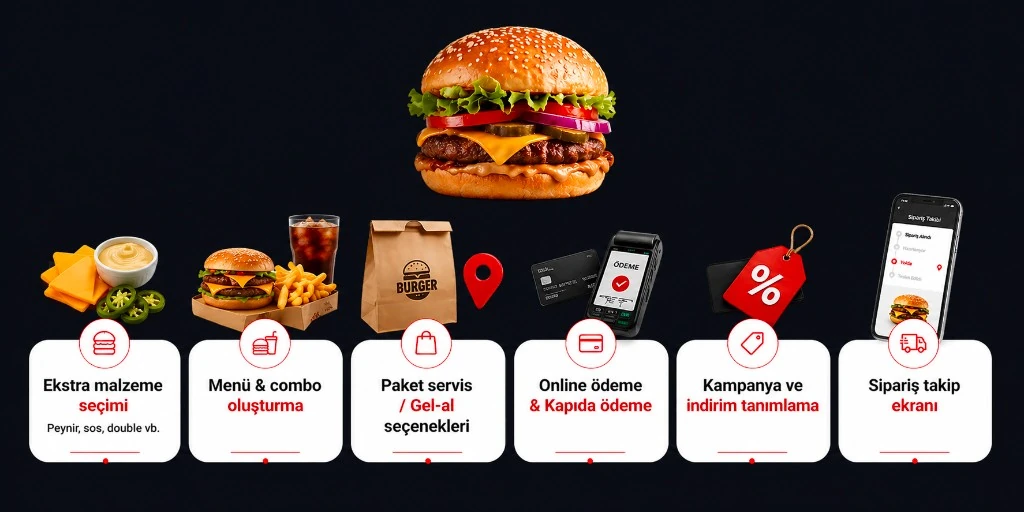
What is the difference between direct ordering and intermediary platforms?
Direct ordering means the customer orders from your own site/QR; there is no intermediary between you and the customer. Intermediary (marketplace) ordering comes through a platform such as Yemeksepeti, Getir or Trendyol; the platform connects you to the customer and takes a share of turnover in return.
The difference is not only price; it lies in the questions of who owns the customer, who holds the data and who controls the relationship.
Side-by-side comparison
- Cost model: The direct channel usually has a fixed subscription + payment processing fee; a marketplace charges a percentage of turnover on every order (often in the 10%–30% range).
- Customer ownership: On the direct channel the customer is yours; on a marketplace the customer is the platform's user.
- Data: On the direct channel order/contact data is yours; on a marketplace it is limited or held by the intermediary.
- Visibility/discovery: A marketplace offers ready traffic and new-customer discovery; on the direct channel you bring the traffic yourself (SEO, social, QR).
- Brand and experience: On the direct channel the logo, theme and flow are yours; on a marketplace it is the standard platform interface.
- Price/campaign control: Full on the direct channel; bound by platform rules on a marketplace.
When does each make sense?
A simple decision framework: if the main need is discovering new customers, a marketplace is valuable. If your priority is repeat customers and protecting margin, the direct channel stands out — because you don't pay commission again on every order from a loyal customer.
- Just opened, low awareness → a marketplace helps with discovery.
- You've built a loyal base → move them to the direct channel.
- High volume + low margin business → the fixed cost of the direct channel is an advantage.
- Both together: manage discovery via marketplace, repeats via the direct channel (hybrid).
Who is it for?
- Businesses that want to balance marketplace commission pressure
- Those who want to move loyal customers to their own channel
- Those who value brand experience and data ownership
- Those who want to build a hybrid (discovery + repeat) strategy
Related topics and resources
- ordering platform commission guide
- commission-free ordering options guide
- commission-free ordering providers
- online ordering system pricing
- mobile ordering system
For details and a demo contact us or review free setup steps.
Frequently asked questions
Does the direct channel fully replace the marketplace?
Not necessarily. Marketplaces are strong for discovering new customers; the direct channel retains repeat customers at low cost. Most businesses use both (hybrid).
Who owns the customer data on the direct channel?
You do. Order, contact and preference data stays in your own panel; you can use it directly for campaigns and repeat sales. On a marketplace this data usually stays with the intermediary.
Do customers need a mobile app for direct ordering?
No — customers order from a mobile browser. See ordering without downloading an app.
Get started
Contact us about an online ordering solution for your business and start taking orders on your own channel with Komisyonsuz.