
Guide
What is commission-free ordering?
Direct ordering is a model where orders through your own channel run on a fixed cost instead of paying a revenue share on every sale.
Short answer
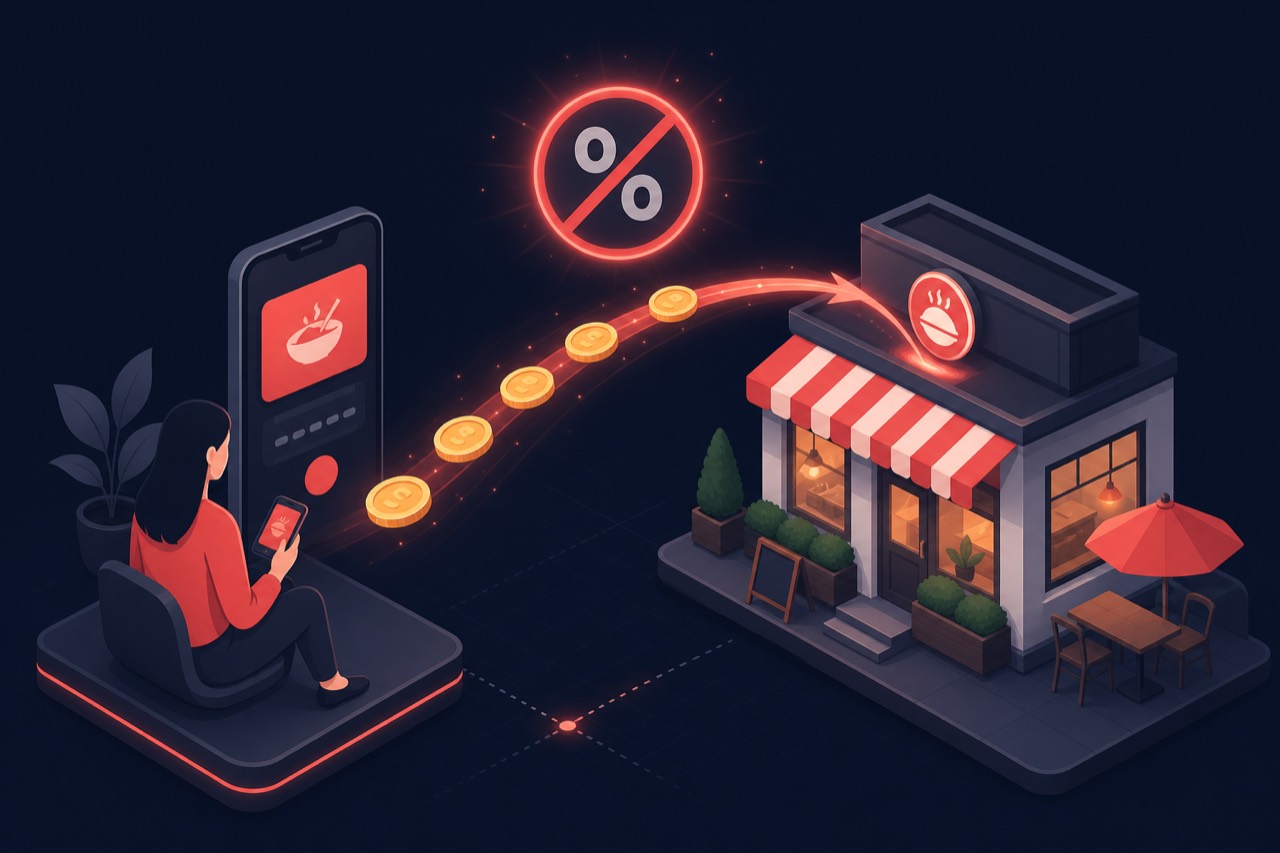
Direct ordering means you do not pay the per-order revenue share marketplaces charge on orders from your own website, app or QR channel. Instead there is usually a fixed/monthly fee; as volume grows, per-order cost falls. Customers buy through your own channel, so revenue, first-party data and communication consent stay with the business.
Definition
Direct ordering is defined by its cost structure: a fixed model instead of a percentage cut per sale. For orders via website, mobile app, QR channel or social link, the business pays no revenue share to an intermediary. The key difference is not that it is free, but that cost is tied to a fixed fee rather than revenue.
Marketplaces commonly take 10–35% per order—a cost that rises with revenue. On your own channel the cost stays fixed, so per-order cost drops quickly above a certain volume. Marketplaces can still be used for acquisition; profitable, repeat orders are gathered on your own channel.
How does the economics work?
The cost logic of your own channel is understood in these steps:
- The business opens an ordering channel (web, app, QR) under its own brand.
- The customer buys directly through this channel; no intermediary takes a cut.
- The sale amount goes to the business; no percentage is deducted from revenue.
- Instead of intermediary share, a fixed/monthly fee is paid; divided by volume, per-order cost falls.
- Above a certain order volume (break-even), your own channel becomes clearly more economical than a marketplace.
Benefits
Your own channel shifts margin and customer ownership to the business.
Fixed, predictable cost
A plannable fee instead of variable revenue share; growth is not penalized.
Lower per-order cost
As fixed fee is spread over rising volume, unit cost per order drops.
First-party data
Order, address and consent data accumulate with you, not the intermediary—enabling remarketing.
Customer ownership
Relationship and loyalty are built under your brand; the customer is yours, not the platform's.
Unit economics concepts
These concepts determine the right model:
Revenue share (commission)
The percentage a marketplace takes per sale. Total cost rises linearly with revenue; at high volume it can be the most expensive line item.
Fixed / subscription model
A periodic fixed fee independent of revenue. Makes cost predictable and rewards growth.
Per-order cost
Total cost divided by order count. On a fixed model it falls as volume rises; on revenue share it stays flat per order.
Break-even point
The order volume where your channel's fixed cost equals marketplace share. Above this point your own channel is more economical.
First-party data
Order and contact data collected directly from the customer. The basis for loyalty and remarketing without intermediary dependency.
Customer lifetime value
A customer's total contribution over time. Ownership and repeat orders are far more valuable than a one-off sale.
Best practices
To get the most from your own channel:
- Add your ordering link to Instagram, Google Business profile and QR receipts to drive traffic to your channel.
- Keep marketplaces but promote your channel with pricing, campaigns and loyalty.
- Calculate your break-even; know from which volume your own channel wins.
- Build loyalty and re-order campaigns with first-party data.
- Define delivery zones, minimum basket and times clearly to control unit cost.
Related guides and solutions
Frequently asked questions
- Is direct ordering completely free?
No—it means independent of revenue share, not free. Instead of a percentage per sale there is usually a fixed/monthly fee. As revenue grows, this model becomes clearly more economical than share-based pricing.
- From which point is my own channel cheaper than a marketplace?
After the break-even point. Calculate the volume where your channel's fixed cost equals the marketplace's revenue share; every order above that is more profitable on your channel.
- Do I have to abandon marketplaces entirely?
No. Marketplaces remain valuable for new customer acquisition; your own channel is the hub for repeat, profitable orders. Both together form a balanced channel mix.
- Do I need my own website for direct ordering?
Not necessarily. With white-label infrastructure a ready ordering channel can go live under your brand and domain within a few days.
Summary
A fixed-cost direct ordering model ties cost to a fixed fee rather than revenue. Above break-even it lowers per-order cost and keeps first-party data and customer ownership with the business. Marketplaces are used for acquisition while profitable orders are gathered on your own channel.
Get started
Contact us about an online ordering solution for your business and start taking orders on your own channel with Komisyonsuz.